
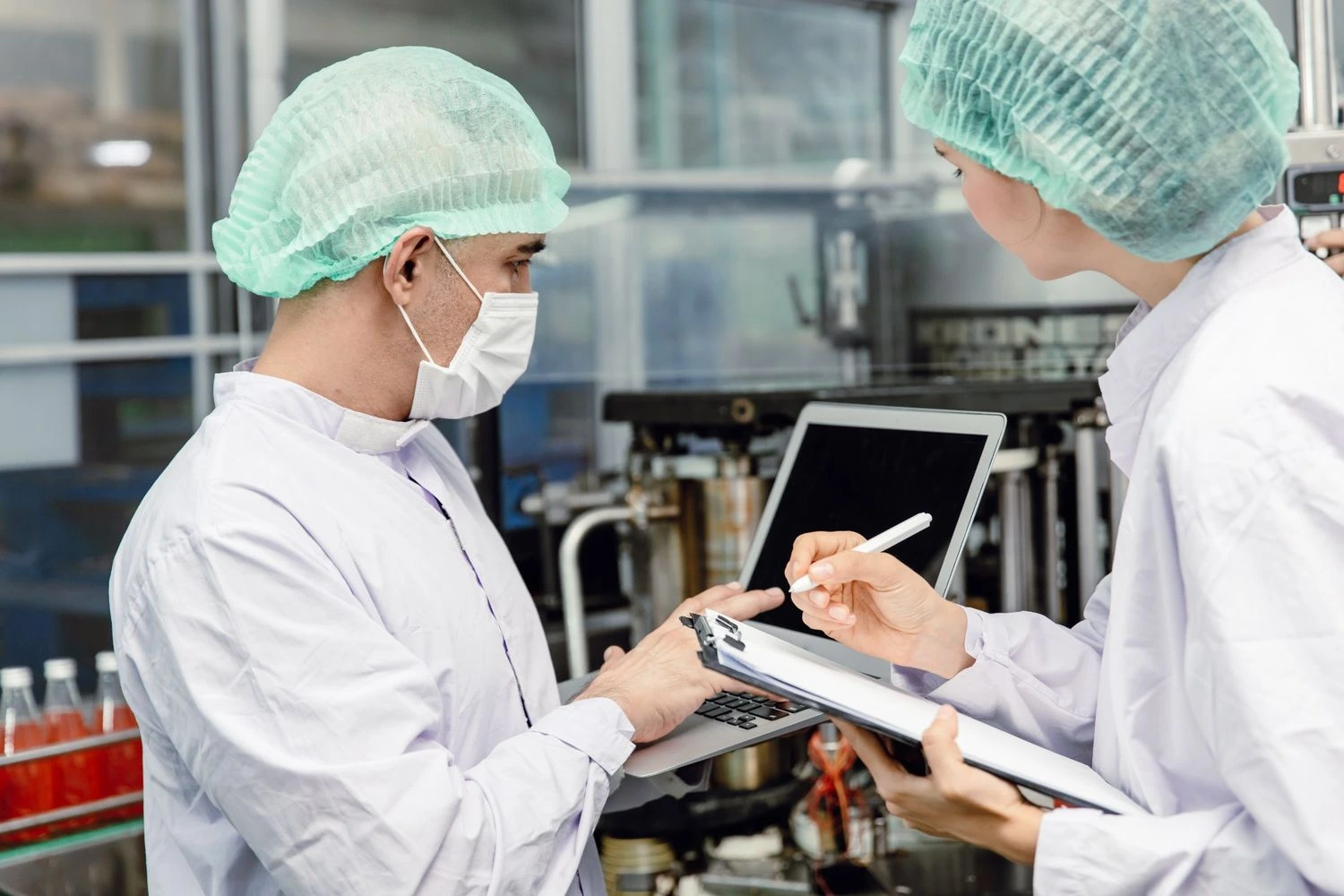
The CGA GMP audit checklist is a structured tool that is used to assess whether the facilities of a manufacturer complies with Good Manufacturing Practices (GMP).
Obtain a Quote or Apply for GMP Auditing
Key GMP Audit Checklist/Requirements for Manufacturers
To pass a GMP audit by CGA, a manufacturer must have demonstrated that it has rigorous control over their production environment. Here’s the comprehensive CGA GMP audit checklist:
| # | Item | Checklist | |
| 1.1.3 | The operation has performed a”mock recall” that was proven to be effective. This exercise must beperformed at least annually. | ||
| Food Safety Plan | |||
| 1.2.1 | The facility must have a food safety plan which is documented and implemented. The plan must include, at a minimum, all documented policies and procedures identified as requirements in this audit standard, in addition to any regulatory requirements | ||
| 1.2.2 | Implementation and oversight of the food safety plan must be under the supervision of one or more competent individuals assigned responsibility for this function. | ||
| 1.2.3 | The facility must document, implement, and record daily, weekly, and/or monthly site inspections as necessary to verify implementation of their food safety plan controls and policies associated with housekeeping, cleaning and sanitation, and maintenance. | ||
| Personnel Qualifications and Training | |||
| 1.3.1 | All personnel who manufacture, process, pack, or hold food must be qualified to perform their assigned duties. Qualifications must be documented. | ||
| 1.3.1.1 | Each individual must be, or be under the supervision of, a qualified individual. | ||
| 1.3.1.2 | Each individual must receive training on the principles of food hygiene and food safety, as appropriate to their role and responsibilities. Training must be provided when first hired, with a minimum of annual refreshers | ||
| 1.3.2 | Supervisory personnel must be assigned the responsibility for personnel compliance with food safety and food hygiene policies and procedures, and have the education, training, or experience (or a combination thereof) necessary to supervise the production of clean and safe food. | ||
| 1.3.3 | Records of training must beestablished and maintained. | ||
| Personnel Hygiene | |||
| 1.4.1 | There shall be a documentedpersonnel hygiene policy that is effectively implemented, with allpersonnel and visitors following the policy.The written policy must include the following elements: | ||
| 1.4.1.1 | The basics of personal hygiene | ||
| 1.4.1.2 | Clothing and footwear | ||
| 1.4.1.3 | Uniforms (if used) – must includerequirements for proper use and maintenance. | ||
| 1.4.1.4 | Gloves (if used) – must include arequirement that they be maintained in an intact, clean, and sanitarycondition. | ||
| 1.4.1.5 | Handwashing (in an adequatehandwashing facility) before starting work, after each absence from the workstation, and at any other time when the hands may have become soiled or contaminated. | ||
| 1.4.1.6 | Removal of unsecured jewelry andother objects that might fall intofood, equipment, or containers, and removing hand jewelry that cannot be adequately sanitized duringperiods in which food is manipulatedby hand. | ||
| 1.4.1.7 | Fingernails (absence of polish; neatly trimmed) | ||
| 1.4.1.8 | Hair restraints | ||
| 1.4.1.9 | Storage of clothing and personal belongings | ||
| 1.4.1.10 | Eating, drinking, and smoking | ||
| 1.4.1.11 | Precautions to protect againstallergen cross-contact with respect to personnel hygiene issues. | ||
| 1.4.1.12 | Control of blood or bodily fluids.The procedure shall specify the procedures for containment andelimination of blood or bodily fluids,and the cleaning and sanitation of surfaces that are affected. | ||
| 1.4.2 | There shall be a documented policyfor control of employee illness.The written policy shall: | ||
| 1.4.2.1 | Include a requirement for employeesto inform management if they are sick or have been infected with a food borne illness. | ||
| 1.4.2.2 | Restrict personnel that are ill fromproduction areas until an assessment of illness takes place to determine what tasks they can perform. | ||
| 1.4.2.3 | Require adequate covering of suchconditions as open lesions, boils, and infected wounds. | ||
| Supply Chain | |||
| 1.5.1 | The facility must document andimplement procedures for receiving raw materials and other ingredients, ensuring that raw materials and other ingredients meet established food safety requirements. | ||
| Processes and Controls | |||
| 1.6.1 | General | ||
| 1.6.1.1 | All facility operations must be conducted in accordance with adequate sanitation principles. | ||
| 1.6.1.2 | Quality control measures must beestablished and implemented to ensure that food and food-packaging materials are safe and suitable forintended use. | ||
| 1.6.1.3 | Sanitation of the plant must be underthe supervision of one or more competent individuals assigned responsibility for this function. | ||
| 1.6.1.4 | Training received: | ||
| 1.6.1.5 | Adequate precautions must be taken to ensure that production procedures do not contribute to allergen cross- contact and to contamination from any source.If color coding is used to identify equipment for various purposes, the system shall be effectively implemented. | ||
| 1.6.1.6 | Documented testing procedures shall be used where necessary to identify sanitation failures or possible allergen cross‐contact and foodcontamination. | ||
| 1.6.1.7 | Food that has become contaminated to the extent that it is adulteratedmust be rejected, or if appropriate, treated or processed to eliminate the contamination. | ||
| 1.6.2 | Raw Ingredients | ||
| 1.6.2.1 | There is a system in place for theproper inspection, handling,segregation, and storage of raw materials. | ||
| 1.6.2.2 | Raw materials must be washed orcleaned as necessary to remove soil or other contamination. | ||
| 1.6.2.3 | Water used for washing, rinsing, orconveying food must be safe and of adequate sanitary quality. Ifrecirculated or reused, the water must be used in a way to preventallergen cross‐contact or an increasein the level of contamination of the food. If the water is treated, treatment must be monitored toverify adequate pH, temperature, and/or chemical control. | ||
| 1.6.2.4 | The facility must identify raw materials and/or ingredients that need pasteurization or other treatment prior to processing toprevent possible contamination from pathogenic microorganisms and implement the necessary treatments.These treatment procedures must be documented. | ||
| 1.6.2.5 | The facility must identify raw materials and/or ingredients that are susceptible to contamination withaflatoxin or other natural toxins and implement steps to ensure compliance with FDA regulationsfor poisonous or deleterious substances.Control measures must be documented. | ||
| 1.6.2.6 | The facility must identify raw materials and/or ingredients thatpose a risk for contamination with pests, undesirable microorganisms, or extraneous material andimplement steps to ensure compliance with FDA regulations for natural or unavoidable defects.Control measures must be documented. | ||
| 1.6.2.7 | Raw materials, other ingredients,and rework must be:- held in bulk or in containers designed and constructed to protect against allergen cross‐contact and against contamination.- held at appropriate temperature and relative humidity and in such a manner as to prevent the foodfrom becoming adulterated. identified for rework, if scheduled for this purpose. | ||
| 1.6.2.8 | Frozen raw materials and otheringredients shall be kept frozen. Temperature of the freezer(s):If product is thawed prior to use, it must be done in a manner thatprevents the raw materials and other ingredients from becomingadulterated. | ||
| 1.6.3 | Allergens | ||
| 1.6.3.1 | There shall be documentedprocedures in place for management to identify all allergenic materials (nine major allergens are peanuts, tree nuts, eggs or egg products, milk or dairy products, crustaceans, finfish, soy and wheat, and sesameseeds; food chemical sensitivities include sulfites and/or food colorings) present in the facility. | ||
| 1.6.3.2 | Identified types of allergens/chemicals: | ||
| 1.6.3.3 | Raw materials and other ingredientsthat are food allergens, and rework that contains food allergens, must be identified and held in a manner that prevents allergen cross‐contact. | ||
| 1.6.4 | Operations | ||
| 1.6.4.1 | Equipment and utensils and foodcontainers must be maintained in an adequate condition throughappropriate cleaning and sanitizing, as necessary. Equipment must be taken apart for thorough cleaning, if necessary. | ||
| 1.6.4.2 | Manufacturing, processing, packing,and holding shall be conducted to minimize the potential for thegrowth of microorganisms, allergen cross‐contact, contamination of food, and deterioration of food. | ||
| 1.6.4.3 | Food that can support the rapidgrowth of undesirable microorganisms must be held at temperatures that will prevent the food from becoming adulteratedduring manufacturing, processing, packing, and holding. | ||
| 1.6.4.4 | Measures such as sterilizing, irradiating, pasteurizing, cooking, freezing, refrigerating, controlling pH, or controlling Aw, that are necessary to destroy or prevent the growth of undesirable microorganisms, must be identified, implemented, and documented. | ||
| 1.6.4.5 | The facility’s product flow and work areas for work‐in‐process (WIP) and rework provides protection against comeling, allergen cross‐contact, contamination, and growth of undesirable microorganisms. | ||
| 1.6.4.6 | Effective measures shall be taken to protect finished food from allergen cross‐contact and from contamination by raw materials, other ingredients, or refuse. Raw materials, other ingredients, or refuse that are unprotected must not be handled simultaneously in a receiving, loading, or shipping area if that handling could result in allergen cross‐contact or contaminated food. Food transported by conveyor must be protected against allergen cross‐contact and against contamination as necessary. | ||
| 1.6.4.7 | Equipment, containers, and utensilsused to convey, hold, or store raw materials and other ingredients, work‐in-process, rework, or other food must be constructed, handled, and maintained duringmanufacturing, processing, packing,and holding in a manner that protects against allergen cross‐contact and against contamination. | ||
| 1.6.4.8 | The facility must take adequate measures to protect against the inclusion of metal or otherextraneous material in food. | ||
| 1.6.4.9 | If the facility identifies food, rawmaterials, and other ingredients as adulterated, they must dispose of the material in a manner that protects against the contamination of other food; or, if appropriate, recondition the material so that it meets process and regulatoryrequirements. | ||
| 1.6.4.10 | Steps such as washing, peeling,trimming, cutting, sorting andinspecting, mashing, dewatering, cooling, shredding, extruding,drying, whipping, defatting, andforming must be performed so as to protect food against allergen cross‐ contact and against contamination.Food must be protected fromcontaminants that may drip, drain, or be drawn into the food. | ||
| 1.6.4.11 | If heat blanching is utilized in thepreparation of food capable ofsupporting microbial growth, the process must be documented and implemented. The blanchingequipment must be periodicallycleaned and sanitized as necessary. | ||
| 1.6.4.12 | If batters, breading, sauces, gravies,dressings, dipping solutions, and other similar preparations are held and used repeatedly over time, they must be treated or maintained in such a manner that they are protected against allergen cross‐contact and against contamination, and to minimize the potential for the growth of undesirable microorganisms. | ||
| 1.6.4.13 | Filling, assembling, packaging, and other operations must be performed in such a way that the food is protected against allergen cross‐contact, contamination, and growth of undesirable microorganisms. | ||
| 1.6.4.14 | Dry mixes, nuts, intermediatemoisture food, and dehydrated food, that rely principally on the control of water activity (Aw) for preventing the growth of undesirablemicroorganisms, must be processed to, and maintained at a safe Aw level.Controls must be documented. | ||
| 1.6.4.15 | Acid and acidified food aremonitored and maintained at a pH of4.6 or below. | ||
| 1.6.4.16 | Ice that is used (internally produced or externally supplied) in contact with food must be made from water that is safe and of adequate sanitary quality and manufactured in accordance with current good manufacturing practices. | ||
| 1.6.4.17 | The identified measures are: | ||
| Defect Action | |||
| 1.7.1 | The facility must determine if defect action levels are established for thefood handled or manufactured by the facility.Controls must be documented. | ||
| Identify defect action levels: | |||
| 1.7.2 | Quality control operations must be conducted in a way that reducenatural or unavoidable defects to the lowest level currently feasible. The policies must be documented, with records of implementation. | ||
| 1.7.3 | The facility shall not mix foods containing defects at levels that render that food adulterated with other lots of food. | ||
| Equipment and Utensils (Design, Materials, and Maintenance) | |||
| 1.8.1 | General | ||
| 1.8.1.1 | All plant equipment and utensilsused in manufacturing, processing, packing, or holding food must bedesigned and of such material and workmanship as to be adequately cleanable and must be adequately maintained. | ||
| 1.8.1.2 | Equipment and utensils must be designed, constructed, and used appropriately to avoid theadulteration of food with lubricants, fuel, metal fragments, contaminated water, or any other contaminants. | ||
| 1.8.1.3 | Equipment must be constructed and located so that they are accessiblefor cleaning, maintenance, and inspection. | ||
| 1.8.1.4 | Food‐contact surfaces must be corrosion‐resistant, made ofnontoxic materials, and designed to withstand the environment of their intended use and of the cleaning process. | ||
| 1.8.1.5 | Food‐contact surfaces must bemaintained to protect food from allergen cross‐contact and frombeing contaminated. | ||
| 1.8.2 | Seams on food‐contact surfaces mustbe sanitary welds, smoothly bonded and maintained to minimize accumulation of food particles, dirt, and organic matter minimizing the opportunity for microorganismgrowth and allergen cross-contact. | ||
| 1.8.3 | Non-food contact equipment locatedin the processing and packing areas shall be constructed so that it can be maintained, and is in good condition, able to be cleaned. | ||
| 1.8.4 | Holding, conveying, andmanufacturing systems must be of a design and construction that enables them to be maintained, and are in an appropriate clean and sanitarycondition. | ||
| 1.8.5 | Freezer and cold storage compartments must be fitted with an indicating thermometer, temperature‐measuring device, ortemperature recording device. | ||
| 1.8.6 | Instruments and controls used for measuring, regulating, or recording temperatures, pH, water activity, etc. must be properly maintained,calibrated, and adequate in number for their designated uses. | ||
| 1.8.7 | Compressed air or other gasesmechanically introduced into food or used to clean food‐contact surfaces or equipment must be filtered and oil free. | ||
| Sanitary Facilities and Controls | |||
| 1.9.1 | General | ||
| 1.9.1.1 | The water supply/system must beadequate for the operations intended and must be derived from anadequate source. Private wells must be inspected on an annual basis. | ||
| 1.9.1.1.1 | There shall be testing results showing that water used for processing, cleaning, as aningredient, or by personnel is potable.Water test results issued by: Date of testing: | ||
| 1.9.1.1.2 | Running water of suitabletemperature and pressure must beavailable in all areas where required for the processing of food, for the cleaning of equipment, utensils, and food‐packaging materials, or for employee sanitary facilities. | ||
| 1.9.2 | Plumbing | ||
| 1.9.2.1 | Plumbing must be of adequate sizeand design to handle the water and waste flow for the facility, and not create possible contamination orunsanitary conditions. | ||
| 1.9.2.2 | Floors, gutters, or drains must have sufficient slope and outlets to drain adequately. | ||
| 1.9.2.3 | There shall not be any crossconnections between treated and untreated supplies. | ||
| 1.9.2.4 | Back flow prevention devices must be installed on all water and steam lines, and periodically certified.Certification by:Date of last certification: | ||
| 1.9.3 | Sewage must be disposed of into an adequate sewage system or disposed of through other adequate means. | ||
| 1.9.4 | For toilet facilities that are located inproduction areas or primarily used by production staff, there must be: | ||
| 1.9.4.1 | An adequate, readily accessible, number of units for the facility size/number of employees. | ||
| 1.9.4.2 | Independent outside ventilation. | ||
| 1.9.4.3 | Design so that they do not opendirectly into food handling areas (i.e., processing, repacking, or reconditioning areas). | ||
| 1.9.4.4 | Self-closing doors or maze-type entrance. | ||
| 1.9.4.5 | Adequate lighting. | ||
| 1.9.4.6 | Sufficient and proper waste receptacles. | ||
| 1.9.4.7 | Signs posted indicating theimportance of hand washing (multilingual if appropriate). | ||
| 1.9.4.8 | Hand-washing facilities with running water at a suitable temperature, soap, and single use towels or forced airhand dryers. | ||
| 1.9.4.9 | Toilet areas that are clean, dry,properly stocked with toilet paper, and of good general appearance. | ||
| 1.9.4.10 | Toilets, sinks, and faucets in good working condition. | ||
| 1.9.5 | Hand-washing facilities (located inbreakroom and production area) shall include running water at a suitable temperature, soap, andsingle use towels or forced air hand dryers. Signs must be postedindicating the importance of handwashing (multilingual if appropriate). | ||
| 1.9.6 | The capacity of the facility’s rubbish/waste storage must besufficient for the operation, with dedicated waste containers and timely removal of waste. A policy must be documented. | ||
| Maintenance and Sanitation | |||
| 1.10.1 | General Maintenance | ||
| 1.10.1.1 | Buildings, fixtures, and otherphysical facilities of the plant must be maintained in a clean and sanitary condition and must be kept in repair adequate to prevent food frombecoming adulterated.After maintenance repairs ofequipment associated with food processing or with food contact surfaces, the equipment must be cleaned, sanitized, and inspected. This policy must be documented, and implementation must berecorded. | ||
| 1.10.1.2 | Cleaning and sanitizing of utensils and equipment must be conducted in a manner that protects againstallergen cross-contact and against contamination of food, food contact surfaces, or food-packagingmaterials. The procedure must be documented and there must be records to show completion. | ||
| 1.10.2 | Sanitation Chemicals and Supplies | ||
| 1.10.2.1 | Cleaning compounds and sanitizingagents used in cleaning and sanitizing procedures must be free from undesirable microorganisms and appropriate for use(documentation must be available for verification). | ||
| 1.10.2.2 | The chemicals stored at the facility must be appropriate for presence in a plant where food is processed andexposed. Food grade lubricantsmust be used in exposed product zones. | ||
| 1.10.2.3 | There shall be a locked storage area for chemicals with controlled access, and chemicals must be clearly andproperly labeled. | ||
| 1.10.3 | Pest Control | ||
| 1.10.3.1 | The facility shall document andimplement an effective pest control program. | ||
| 1.10.3.1.1 | A pest control station map isproperly maintained and available. | ||
| 1.10.3.1.2 | Routine maintenance and inspection of pest control devices isdocumented. | ||
| 1.10.3.1.3 | The type, number, and placement of pest control/deterrent devices isadequate and appropriate to prevent infestation. | ||
| 1.10.3.1.4 | The facility is free from pest infestation. | ||
| 1.10.3.2 | The use of pesticides to control pests in the facility must be performedunder precautions and restrictionsthat will protect against thecontamination of food, food-contact surfaces, and food packaging materials. | ||
| 1.10.4 | Sanitation of Food-Contact Surfaces | ||
| 1.10.4.1 | All food-contact surfaces, including utensils and food-contact surfaces of equipment, must be cleaned asfrequently as necessary to protect against allergen cross-contact and against contamination of food.The procedure must be documented and there must be records to show completion. Cleaning and sanitation oversight must be assigned to at least one competent staff person. | ||
| 1.10.4.2 | For processing, packing, or holdinglow-moisture food, food contact surfaces must be clean and dry before use. If wet-cleaned, the surfaces must be sanitized andthoroughly dried before use. Theprocedure must be documented and there must be records to showcompletion. | ||
| 1.10.4.3 | In wet processing, all food contact surfaces must be cleaned andsanitized before use and after any interruption during which the food contact surfaces may have become contaminated. Where equipmentand utensils are used in a continuous production operation, the utensilsand food-contact surfaces of the equipment must be cleaned and sanitized as necessary. Theprocedure must be documented and there must be records to showcompletion. | ||
| 1.10.4.4 | Single-service articles must bestored, handled, and disposed of in a manner that protects against allergen cross-contact and againstcontamination of food, food-contact surfaces, or food packaging materials. | ||
| 1.10.5 | Non‐food contact surfaces ofequipment used in the operation of a food plant must be cleaned in amanner and as frequently asnecessary to protect against allergen cross‐contact and against contamination of food, food‐contact surfaces, and food‐packaging materials. | ||
| 1.10.6 | Cleaned and sanitized portable equipment with food‐contactsurfaces and utensils must be stored in a location and manner that protects food‐contact surfaces from allergen cross‐contact and fromcontamination. | ||
| Warehousing and Distribution | |||
| 1.11.1 | The storage and transportation offood must be carried out so that it is protected against allergen cross‐ contact and against biological, chemical (including radiological), and physical contamination of food, as well as against deterioration of the food and the container. | ||
| 1.11.1.1 | Incoming trailers and goods are inspected for damage, infestation,off odors, contamination, and proper temperatures. | ||
| 1.11.1.2 | Wash certificates are required for bulk tanker trucks for previousloads. The record indicates the previous product shipped. | ||
| 1.11.1.3 | Procedures are implemented for outbound shipments, including:proper shipping temperature, trailer cleanliness/condition, verification of odors, etc. | ||
| 1.11.1.4 | Packaging, packing materials, andempty containers must be protected from contamination. | ||
| 1.11.1.5 | Retained, damaged, or returnedproduct must be identified and stored in a clearly designated area orcontrolled through an inventory system. | ||
| 1.11.1.6 | The facility must have a documented procedure to ensure that ingredients, materials, work in progress, andfinished product are used in the correct order and within the allocated shelf life. | ||
| Food By-Products for Animal Food | |||
| 1.12.1 | If the facility holds and distributes human food by-products for use as animal food, it must be held under conditions that protect against contamination, including: | ||
| 1.12.1.1 | Containers and equipment used toconvey or hold human food by‐products before distribution must be designed, constructed of appropriate material, cleaned as necessary, and maintained to protect againstcontamination. | ||
| 1.12.1.2 | Human food by‐products must beheld in a way to protect againstcontamination from sources such as trash. | ||
| 1.12.1.3 | Human food by‐products must beaccurately identified. | ||
| 1.12.2 | Labeling that identifies the by‐product by the common or usual name must be affixed to oraccompany human food by‐products for use as animal food when distributed. | ||
| 1.12.3 | Shipping containers and bulkvehicles used to distribute human food by‐products must be examined prior to use to protect against contamination of the human food by‐ products from the container or vehicle. | ||
| Facility and Grounds | |||
| 1.13.1 | The grounds surrounding the facility must: | ||
| 1.13.1.1 | Be maintained in a manner whichwill prevent rodent and insectharborage, reasonably free of litter and debris. | ||
| 1.13.1.2 | Be properly surfaced and designed to prevent dust and offensive odors and for adequate drainage (minimal standing water). | ||
| 1.13.1.3 | Include an adequate number ofexterior waste containers which are well maintained and in goodcondition.The frequency or removal of the waste shall be timely.A policy must be documented. | ||
| 1.13.1.4 | Not be affected by uncontrolledcontamination risks from adjacent properties. The facility shall take steps for additional inspection,extermination, or other means to limit any identified risks. | ||
| 1.13.2 | The plant design and construction shall be adequate for the food products produced. | ||
| 1.13.2.1 | There must be adequate spaceprovided for necessary maintenance, sanitation, and production activities. | ||
| 1.13.2.2 | The facility must be designed toprevent contamination of products and materials. Measures may include physical segregation, time, air flow systems, enclosures,labeling, and other effective means. | ||
| 1.13.2.3 | Bulk storage vessels shall beconstructed and protected to prevent contamination. | ||
| 1.13.2.4 | Floors, doors, ceilings, walls and overheads must be in good repair and designed to facilitate proper sanitation and maintenance. | ||
| 1.13.2.5 | There shall be adequate proceduresin place to prevent overheadcondensation from dripping on tofood, food contact surfaces, or food- packaging materials. | ||
| 1.13.2.6 | Catwalks and stiles must beconstructed and located to prevent product contamination. | ||
| 1.13.2.7 | There shall be sufficient lighting inpersonnel areas, and to permit efficient operations and cleaning where food is examined,manufactured, processed, packed, or held and where equipment orutensils are cleaned. | ||
| 1.13.2.8 | Light fixtures and other glass mustbe properly covered or protected in case of breakage. | ||
| 1.13.2.9 | Fans and other air-blowingequipment shall be located so to minimize the potential for allergen cross-contact and for contaminating food, food packaging materials, and food-contact surfaces. | ||
| 1.13.2.10 | Buildings shall be reasonably free from excessive dust, heat, steam, condensation, vapors, smoke orfumes. | ||
| 1.13.2.11 | Doors, windows, and other gateways shall be closed or properly protected with screens, air screens or other protective devices. | ||
Bundle and Save with Multi-Certification Audits
Maximize your facility’s efficiency by combining GMP audits with other essential certifications, saving on both cost and time:
- GMP + Non-GMO Verification
- GMP + Vegan Certification
- GMP + Halal Certification
Duration and Frequency of CGA Audits
There are different scopes to approach GMP auditing, and they depend on the size of your facility and its regulatory requirements. The duration of a CGA GMP audit can typically last from a few days to several weeks, also depending on the size of the business. How often are CGA audits carried out?
- Internal Audits: It is common practice to conduct comprehensive, internal GMP audits at least once every year.
- External Audits: For external, third-party audits, we recommend its conduction every two to three years, or as stipulated by the specific certification body that regulates an industry.
Speak to a GMP Expert
Our GMP experts and manufacturing compliance specialists are here to help you navigate the complexities of global standards and certifications.
We will guide you through the audit checklist and requirements for conducting a thorough auditing. Send a call through to our manufacturing division today at +1 (813) 906-8113 or complete this form.
Industries Served

Agriculture

Packaged Goods

Food & Beverage

Industrial Manufacturing
Nutraceutical & Supplements

Pharmaceuticals

Logistics
Cosmetics
